Sometime around 4.68 billion years ago the solar system in which the planet earth exists, formed out of the condensing matter present in the cosmos.
The gravitational forces acting on a small portion of the residual matter formed during the big flash of the creation of the cosmos (13.8 billion years ago) coalesced into a “giant” molecular cloud.
Most of the matter of that cloud coalesced at the center of the cloud forming the hydrogen rich proto-sun, while the rest of the matter rotated and flattened into a proto-planetary disk out of which the planets, moons, asteroids, comets, meteorites, and other small Solar System bodies formed.
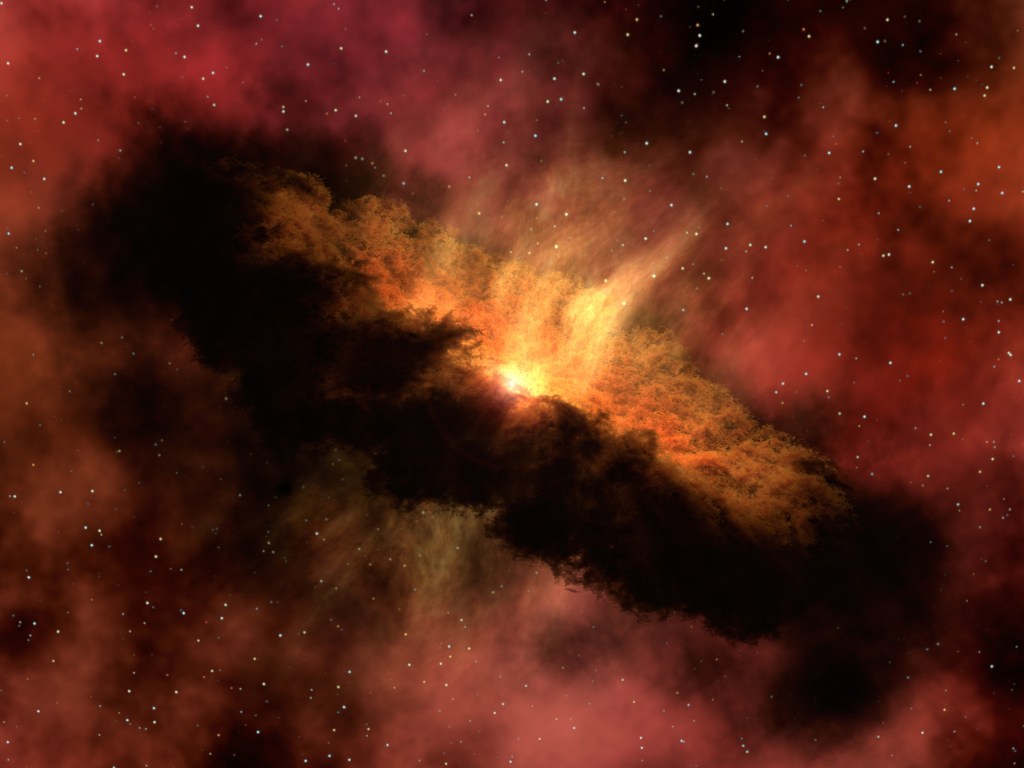
The Actual “Big Bang” of the Divine Creation; the Solar Ignition Event:
At some point during this period of coalescence (4.68 to 4.63 Ga), the condensing matter of the Proto-Sun ignited in a hydrogen fueled nuclear fusion reaction (the sun became the gargantuan and sustained “H-bomb” that it is to this day). Although the Sun was only about two-thirds as bright as it is today, the process of ignition (the so-called T-Tauri phase) was energetic enough to blow away most of the gaseous part of the proto-planetary disk.
The Terminology of Galactic Time: Two of the units of time used to describe these very ancient events are the Ga (or Gya) and the Ma (or Mya). The Ga is the abbreviation for Giga annum is 1×10⁹ (or a billion) or Gya for Giga years ago; alternatively the Ma (or Mya) is the abbreviation for millions of years ago; so 4.6 Ga (billion years ago) = 4600 Ma (or million years ago).
This theory of formation is known as the Nebular Hypothesis. The nebular hypothesis, was first developed in the 18th century by Emanuel Swedenborg, Immanuel Kant, and Pierre-Simon Laplace.
The heliocentric view of the solar system was first describe by the ancient Greek astronomer and mathematician Aristarchus of Samos around 285 BC. He put the then known 5 planets in the correct order of their distance from the sun. Aristarchus’ correct idea was overshadowed by the permeative fallacy Artistotle’s Geocentric cosmology until Nicolaus Copernicus restored and confirmed the truth of the heliocentric concept of the solar system in 1539.
The Birth of the Earth – “The Big Splash”:
The matter of the solar nebula collided and coalesced from individual free molecules into dust grains, which settled together by gravitational accretion and collected into clumps, then chunks, then boulders, and finally bodies called planetesimals large enough to exert their own gravity. As time went by, planetesimals collided with other bodies and grew larger. As they did, the energy of each collision was tremendous. By the time they reached a hundred kilometers or so in size, planetesimal collisions were energetic enough to melt and vaporize much of the material involved. The rocks, iron, and other metals in these colliding worlds sorted themselves into layers. The dense iron settled in the center and the lighter rock separated into a mantle around the iron, in a miniature of Earth and the other inner planets today. Planetary scientists call this settling process differentiation.
It didn’t just happen with planets, but also occurred within the larger moons and the largest asteroids. The iron and nickle containing meteorites that we can occasional see and which occasional plunge to Earth from time to time come from collisions between these asteroids in the distant past.
The chunks, boulders, and planetesimals left behind continued to collect into a handful of large, stable bodies in well-spaced orbits. Earth was the third one of these, counting outward from the Sun. The process of accumulation and collision was violent and spectacular because the smaller pieces left huge craters on the larger ones. Studies of the other planets show these impact scares and today the evidence is strong that they contributed to catastrophic conditions on the infant Earth.
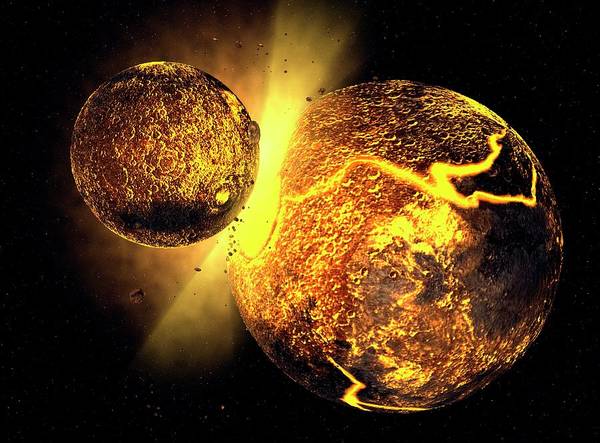
At one point early in this process (around 4.533 to 4.527 Ga or about 0.3 Ga after the Big Bang of solar ingnition) a very large (Mars sized) planetesimal struck the nascent Earth in an off-center blow and sprayed much of the young Earth’s rocky mantle into space. This was The Big Splash, so there was a Big Flash (the origin of the cosmos), a Big Bang (when the sun ignited) and the Big Crash (or splash) when the moon was formed; there is a lot of drama in this creation thing.
The planet earth got most of its matter back after a period of time, but some of that matter collected into a second planetesimal circling Earth. Those leftovers are thought to have been part of the Moon’s formation story. A similar phenomenon explains the formation of the rings of the planet Saturn which never coalesced into a moon and rather became “dust belts.”
If these post are interesting to you, you may also be interested in viewing: https://www.chosendemos.com/
 Lange's Christian Chronicle