Saint Luke the Evangelist also known as Luke the Physician and Luke the First Iconographer
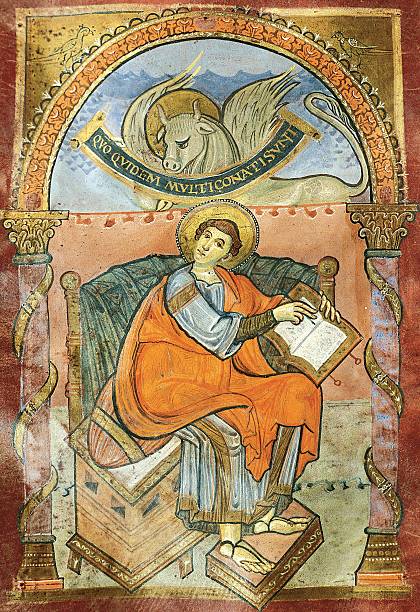
Luke the Evangelist is one of the four evangelists (one of the authors of the four Gospels of Jesus Christ). He was the author of both The Gospel According to Luke (written around AD 60 to AD 63) and the sequel to that gospel, the Acts of the Apostles (written around AD 62 to AD 64), which originally formed a single literary work, referred to as Luke-Acts. Luke’s authorship of these two works means that Luke contributed over a quarter of the text of the New Testament; more than any other author. He was NOT one of the twelve apostles chosen by Christ.
According to Hippolytus of Rome (AD 170 to 235), Luke was one of the seventy disciples of Christ. Hippolytus was a disciple of Irenaeus of Lugdunum who was, in turn, discipled by Polycarp of Smyrna, who was a disciple of the Apostle John the Evangelist. The sequence of the lives of these four pious and influential Christians is a classic example of the full concept of the apostolic succession of the growing church body of the early Christians.

Luke was also a Jewish native of the bustling and wealthy Hellenistic trading city of Antioch (located on the Orontes River, about 15 miles inland from the Mediterranean coast of modern-day Syria). He was well educated, both in Hebrew School in his local Synagogue and he was educated in the classical Greek Paedia and subsequently as a physician in the principles of the Hippocratic School of Greek medicine.
Antioch was one of the long established terminal sea port destinations on the Mediterranean which the the Silk Route traders traveled to. The Silk Route was a group of trade routes from eastern China, through the fertile Transoxinia river valley, north of the Himalayan Mountains and then south west through Persia south of the Caspian Sea to the Greco-Roman cities around the Mediterranean Sea. This well travel trade route had been an active avenue of ancient commerce since at least the early days of the Persian Empire, 600 years earlier.

Luke lived and practiced his medical profession in Antioch. Luke, Mark & Paul were highly educated, “enlightened” and cosmopolitan men who were instrumental in propagating the nascent Christian faith and in documenting the life and the works Jesus the Christ and His apostles and disciples. It is remarkable that these three diasporic Jews, were NOT from Jerusalem or the region of Palestine. Mark was born and raised in the large commercial city and busy sea port of Cyrene (located on the coast of modern day Libya) and Paul was from the busy commercial sea port and trading city of Tarsus in Cilicia (in southern Anatolia, modern day Turkey). The three of them were fairly unique among the other apostles and early disciples who were wise, rich in common sense, and practical knowledge, but not formally educated men.

Around AD 30, Luke heard that the promised Messiah of God, prophesied in numerous ancient Jewish scriptures was the person Jesus the Christ, in Galilee north of Jerusalem. Luke immediately traveled the 300 miles form Antioch to Palestine and found Him. Luke soon affirmed the validity that Jesus was, in fact, God’ promised Messiah, and he avidly accepted Christ’s preaching of salvation from the Lord Himself. As one of the Seventy Disciples of Christ, Saint Luke was a direct eye witness of the Christ during the Savior’s earthly life(Luke 10:1-3), and Luke was soon sent out by Jesus with the other apostle and disciples to preach that the Kingdom of Heaven was at hand.
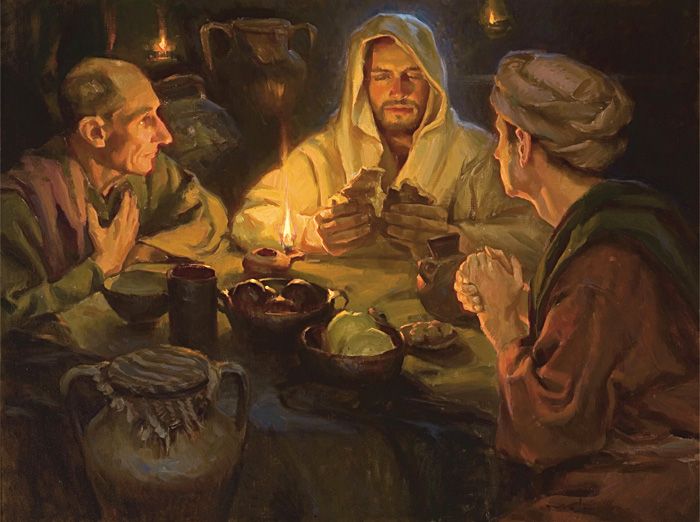
After the crucifixion, death, burial, and subsequent Resurrection, of Jesus, it was Luke (and his companion Cleophas) that the previously dead, but now risen from His grave, Lord Jesus Christ joined while they were discussing what the crucifixion of Christ meant. The initially unrecognized Jesus walked and talked with them as they despondently proceeded along the road to the village of Emmaus (which was 7 miles north and west from Jerusalem). They did not recognize Jesus the Christ for who He was, until they broke bread with Him in the village of Emmaus(Luke 24:13-35). This was early re-enactment the holy communion Christ ordained at His last supper.
In his Letter to the Colossians, the Apostle Paul writes of Luke’s constancy as a companion “Luke, the beloved physician, … greets you(Colossians 4:14).” Luke accompanied Paul on many of Paul’s evangelical travels after Paul’s miraculous conversion (around AD 37). Together they spread the good news that the Kingdom of Heaven was “at hand“(Phil. 1:24, & 2 Tim. 4:10-11). Luke accompanied Paul on his second missionary journey (in AD 49), which Luke documented, and from that time on, they were inseparable travelers. When Paul’s other coworkers had forsaken him, only Luke remained to assist him in his ministry “only Luke is with me(2 Tim. 4:10-11).” Note that Paul’s Second Epistle to Timothy was written by Paul while he was in Rome near the time of Paul’s arrest and martyrdom (around AD 66 or 67).
The generally accepted Christian oral tradition states that after the first-ranked apostles Peter and Paul finished their earthly lives with their martyrdoms in Rome, that Saint Luke left Rome to preach around Italy, Dalmatia, Macedonia, in Achaia (on the Peloponnesian Peninsula of Greece), and then he traveled to Libya (north central Africa), Egypt and the Thebaid (south of Egypt, the “Upper Nile” region around modern-day Khartoum in the Sudan).

Luke is also reputed to be the founder of Christian iconography. Christian oral tradition also states that Luke was the first icon writer, i.e., icon painter (the first written record of this is from the 8th century). He is said to have written (painted) icons of the most Holy Theotokos (the Virgin Mary holding the Christ Child), not just one, but three, including the Hodegetria image (Hodegetria is Greek for she who shows the way) in Constantinople and Icons of the Holy Apostles Peter and Paul. Again Luke had spent a considerable amount of time with the subjects of these icons, and he knew their faces well.
Saint Luke’s earthly life ended at the age of 84 when he suffered martyrdom. He was martyred by Hellenistic idolaters who tortured him and hanged him on an olive tree in the town of Thebes (in Beothia in Greece).
Luke’s miracle-working relics, among others, were translated from Thebes to the Church of the Holy Apostles in Constantinople during the 4th-century, under the reign of Emperor Constantius (AD 357), the son of Constantine the Great.
In AD 1204, the Crusaders of the Forth Crusade stole Luke’s relics from Constantinople and transported them to Padova in Italy and placed them in the Catholic church of Santa Justina at the center of the city where they are presumably (mostly) still present.
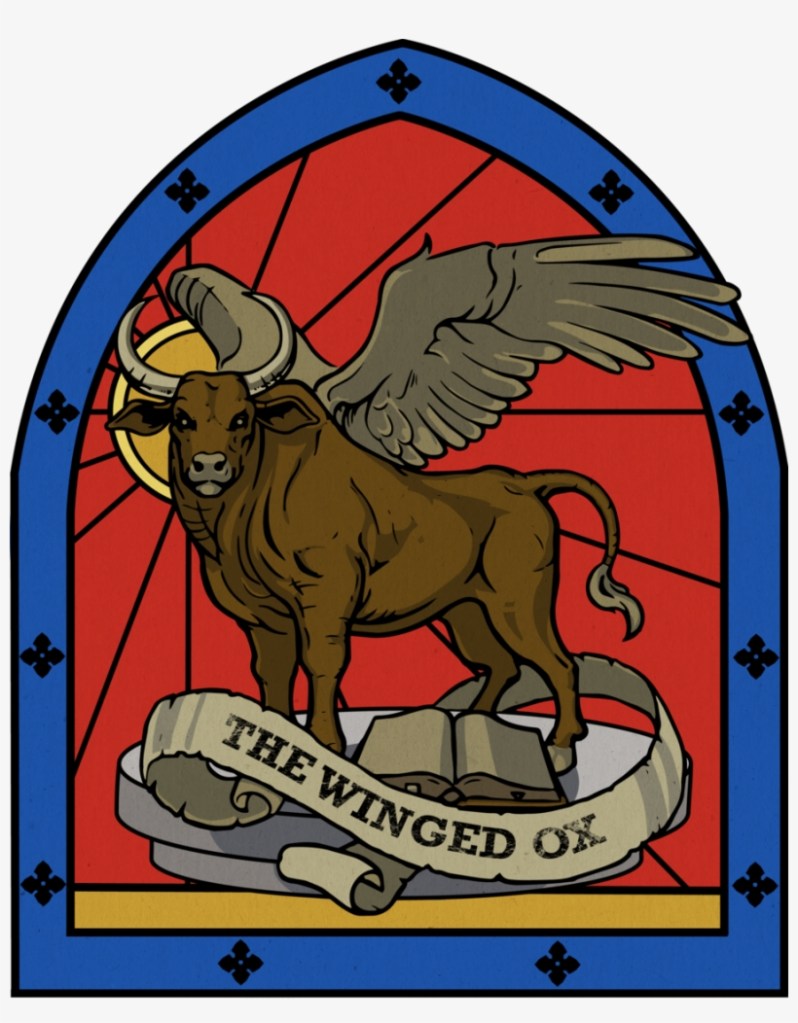
Early Christian illustrations of the four evangelists depict them as “the four living creatures” (the cherubim) which are described as being around the throne of God in Heaven (Ezekiel 1:2-10 & Revelations 4:7-9). Saint Luke is symbolized as a winged ox or bull, (along with Matthew who is shown as a winged man or angel, Mark, who is shown as a winged lion, and John who is shown as an eagle).
If these post are interesting to you, you may also be interested in viewing: https://www.chosendemos.com/
 Lange's Christian Chronicle