“The liturgy is the transcendent place where mystery meets reality!” – Bishop Bower (ACC).
The Christian liturgy is the ritual process by which an ordained Christian priest regularly guides the church into sacred and mystical union with God the Father, the Son and the Holy Ghost, which crescendos in the believer obediently consuming the body and blood of Christ in that Holy presence (as exemplified in the last supper of Christ on the eve of His arrest, the day before He was crucified).
From the earliest days of the nascent Christian church, the practice of the church was to gather in community and to commune and worship God using a thoughtfully organized and systematic liturgical form of worship to God, led initially by one of the apostles of Christ, and then by those ordained by Christ or by one of his apostles or subsequently by their personally trained and formally ordained successors.
The succession of the full understanding and practice of the Christian faith (in knowledge, practice and experience) by these authorized apostles, deacons, priests, and bishops is the full and legitimate concept of the apostolic succession of the faith beginning at the time of Christ and continuing during the Bible-less early decades of the church and continuing after the cannon of the Holy scriptures of the New Testament was compiled and combined with the Hebrew scriptures which formed the Old Testament which became the Christian Bible (which was first formally affirmed by a synod of the church at Hippo-Regius, in AD 393). This authoritative and divinely inspired “book” was agreed upon by the whole church, in the fourth century of that church. The faith of the early church was truly apostolic (connected by the personal succession of the truth of the faith, and the experience of the faithful, from Christian to Christian), and the worshipful practice of that faith was liturgical. The true source of the authority of the Christian leaders of the early church was never “only the Holy scriptures,” it was the undiminished faith and practice of the men and women of that church who were taught and descipled by their predecessors, in the person and by works of God and Jesus Christ, its savior, founder and sustainer.
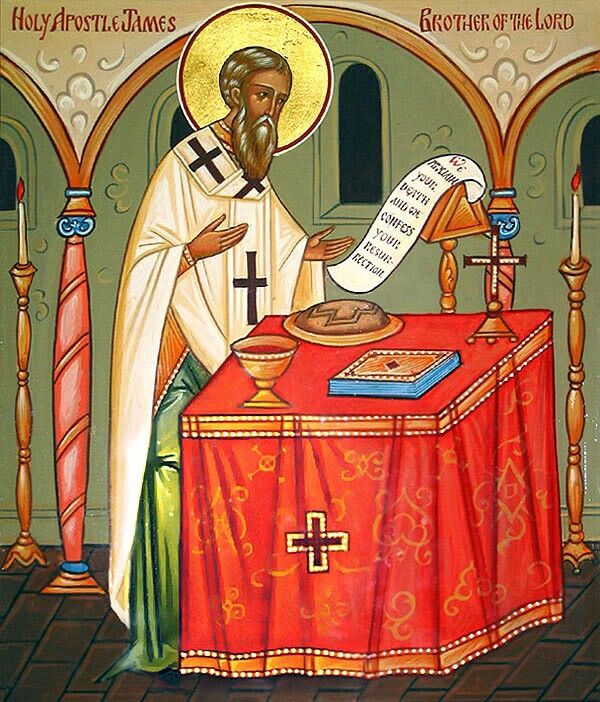
The Liturgy of Saint James the Righteous (James, the Brother of Jesus, the first Bishop of Jerusalem), which was practiced in The Jewish Sect of the Nazarene which then later became the nascent Christian Church is oldest surviving record of the worship practice of that ancient Christian church.
It is traditionally believed to have been developed by the nascent Christians in and around Jerusalem, under the mentorship and guidance and with the leadership of Saint James the Brother of Christ, between the time of James’ ordination by in AD 38 by the apostles Peter, James the son of Zebedee, and John (per Eusebius of Caesarea), and his martyrdom in Jerusalem by the Jewish high priest Ananus in AD 62 (per Josephus).
This liturgy was routinely and regularly used in the divine worship of the Christian Church in Jerusalem, and then in the church at Antioch (where the believers were first called Christians), and it was further developed and slightly modified and used elsewhere throughout the Roman Empire and beyond (e.g. the Aramaic speaking regions of the Fertile Crescent outside of the Roman Empire and within the Parthian Empire, and even beyond those bounds).
This nascent Christian liturgy is a derivative modification of the original source material of the Jewish liturgies which were being performed by the pious and orthodox Jews at the time of Christ, with which James the brother of Christ was, of course, quite familiar with. Specifically the Jewish Liturgy of the Temple which emphasized the daily sacrifices specified in the Law of Moses which was practiced in Jerusalem (and in other diasporic Jewish temples on Mount Gerizim, in Babylon, in Alexandria, and in Cyrene) and the Jewish Liturgy of the Synagogue which was a “liturgy of the word”, i.e., a liturgy which crescendos with a sermon (which had been developed in the many Jewish diasporic communities widely scattered throughout the Roman Empire and beyond).
The liturgy of Saint James, modified and adjusted the traditional Jewish liturgies to accommodate the fact that the promised Messiah of God had come to the earth and died for the sins of mankind, bring salvation to the people of God, and that He could now be worshiped and adored by Christians and that Christians could thereby regularly encounter and experience a transcendent sacred and mystical union with God the Father, the Son and the Holy Spirit (and thereby could fellowship with the whole Christian church, worldwide, the living and the departed, “the quick and the dead”).
The early portions of the nascent Christian liturgy are similar to the Jewish ritual of the synagogue and the liturgical crescendo in the Eucharist has obvious similarities to the Jewish temple sacrifices of personal and national atonement, but now, instead of sacrificing an animal on the alter of God, the Holy practice remembers and mystically participates in the death of Jesus the Christ (the sacrificial atonement of the unblemished lamb of God) and communes with God, the Father, the Son, and the Holy Ghost.
The Emphasis of the Divine Liturgy on Mystical Union of the Faithful with the Living Triune God:
It is a recent, post “reformation” protestant idea that the most important and “uplifting” portion of the Sunday service is the sermon. The ancient church always saw the mystery of regularly meeting and entering into the presence of God at the alter as the essence of the Christian faith and of the regular Christian ritual of the Holy worship service of the faithful to God.
The Details of the Earliest Liturgy of the nascent Christian Church:
The Liturgy of Saint James (a.k.a.: The Liturgy of Jerusalem or The Liturgy of Antioch) has the following order of service:
- Readings from Scriptures, including the Old Testament, the newly extant Epistles, Acts, and Gospels (these readings were directed to the not yet baptized catechumens, the new “God seekers”).
- A sermon from the bishop which was directed to the catechumens of the church.
- A dismissal of the catechumens (who not yet ready to experience the sacred and mystical union with God which occurs during the crescendo of the practice of communion).
- A prayer for the faithful.
- The kiss of peace and words of greeting from the bishop to the faithful present.
- The washing of hands (of the celebrant).
- The offering of gifts (of the bread and the wine to be consecrated, and of a portion of the providence which God had provided to the faithful, i.e., the tithes of the people).
- The consecrate and celebration of the Holy Eucharist including the confession of the faithful, the absolution of the faithful, the prayers of preparation to receive the body and blood of the living Christ (e.g.,, the Sanctus), the words of institution, the anamnesis (the remembrance of the faithful departed saints), the epiclesis (the invocation of God’s Holy Spirit), intercessory prays for the whole church, for the living, and for the dead, preparatory prayers for communion, the distribution of the elements of communion, and a post-communion prayer of thanksgiving.
- The final blessings from the bishop upon the faithful present and their dismissal.
If these post are interesting to you, you may also be interested in viewing: https://www.chosendemos.com/
 Lange's Christian Chronicle